Tuesday, August 9, 2011

Shoin-jinja Shrine in Setagaya of Tokyo

Shoin-jinja Shrine was built in 1882 to enshrine Shoin Yoshida(1830-1859) who was a scholar of the Choshu Domain, current Yamaguchi Prefecture. This site had been used as a Choshu Domain leader's quaters in Edo.
This is a sitting statue of Shoin Yoshida. After studying in Choshu Domain, Shoin went to Edo(=Tokyo) to study under Shozan Sakuma in 1851. When Commodore Perry came to Japan in 1853, Shoin went to see the black ship in Uraga and made up his mind to study abroad.  He went to Nagasaki to try to get on board a Russian warship. The next year when Perry came to Japan for the second time, Shoin went to Shimoda to get on board an American ship. Both attempts ended in vain and Shoin was sent back to Choshu and was detained in a jail.
In 1855 Shoin presided a cram school named 'Shoka-son-juku' in Choshu Domain where he educated Hirobumi Ito(=the first Prime Minister of Japan), Shinsaku Takasugi and others who later became the leaders of the Meiji Restoration.
In the precinct of Shoin-jinja Shrine there is a model house of Shoka-son-juku Cram School.

A list of people who studied under Shoin.

In 1858 Edo Government made the Treaty of Amity and Commerce with the United States without Emperor's permission. Shoin critisized it and tried to assassinate Edo Government's high ranking officer Akikatsu Manabe. Shoin was arrested and detained in a jail. In 1859 Naoseke Ii, the second highest ranking officer after Tokugawa Shogun decided to purge extremists who were against the opening of Japan to foreign countries including Shoin who was finally excuted. 
Soon after the excution Shoin was buried in Kozukahara Kaiko-in Temple in Arakawa of Tokyo but in 1863 his ashes and bones were transferred and buried in his current cemetary in Setagaya. 
In this cemetary Choshu Domain's influential people have also been buried.

Written and posted by an interpreter Mitsutoshi Masunari. I have a national license as an interpreter and tour guide which covers all over Japan. Send me an e-mail for your request: mitch68canada@yahoo.co.jp
  

Monday, August 8, 2011

Setagaya Kan-non-ji Temple in Tokyo

I grew up in Setagaya Ward of Tokyo and lived there until I turned 33. In 1961 a new temple was built in Setagaya by a Buddhist priest Bokken who asked Senso-ji Temple in Asakusa to preside the inauguration ceremony and consecrate the new temple and a Goddess of Mercy.
This is another entrance of Setagaya Kan-non-ji Temple which is in the center of a quiet residential area.
The Goddess of Mercy which had been preserved in Ise of Mie Prefecture was invited to this temple as the idol.

Another Goddess of Mercy which changes our nightmare into a good luck.

Naki-ryuu, a crying dragon being attached to the ceiling of the main gate. When you clap your hands, you can hear the dragon crying. 
Odawara Local Administrator's house was relocated from Odawara to Setagaya.

During World War Ⅱ, a lot of young pilots lost their lives as special attack corp; they have been enshrined here.
My parents' daily visit to this temple were answered; they lived happily until they passed away in their 90s.


Monday, August 1, 2011

Odawara Castle and Kinjiro Ninomiya

Odawara City is situated in the south west corner of Kanagawa Prefecture. It takes only 35 minutes from Tokyo Station to Odawara station by a bullet train, shinkansen. If  you take a local train, it takes an hour and 24 minutes. The reason why I introduce Odawara Castle is that it is the nearest castle from Tokyo which has a long history. 
Odawara Castle was built in 1417. This castle is famous as a stronghold of the Late Hojo Clan. Historians call them the Late Hojo Clan because they were different from the Hojo Clan during the Kamakura Era(1192-1333).

This is a picture of Sagami Bay which I took from the observatory of the castle. I saw foreign tourists enjoying the view.
In the precinct of Hotoku Ninomiya-jinja Shrine near Odawara Castle, there is a statue of Kinjoro Ninomiya(1787-1856). Kinjiro was born to a poor peasant family, but he studied hard on his own.

 After Kinjoro grew up, he named himself  as 'Sontoku Ninomiya'. Sontoku became a prominent agricultural leader, philosopher, moralist and economist.


Thursday, July 7, 2011

Lafcadio Hearn aka Yakumo Koizumi

Who do you imagine when you heard the family name Koizumi? The former Prime Minister Jun-ichiro Koizumi?
His born name was Patrick Lafcadio Hearn; later he named himself Yakumo Koizumi when he was naturalized in Japan in February, 1896. 
Born in Greece(1850):
His father was Irish and mother was Greek. He was born in an small island of Greece 'Lefkada' when his father worked as a doctor of the British Army there. Lefkada was the origin of his middle name Lafcadio. His life was not an easy one.
Brought up in Ireland(1852-1869):
When he was two years old, he moved to Dublin with his mother; that was his father's hometown. His mother didn'd get used to the life in Dublin while his father met his first love who had been already a widow. When Lafcadio was 7 years old, his parents divorced. Since then he was brought up by his grand-aunt. He lost his sight of his left eye in his playgound accident when he was 16; he honed his ESP to overcome the handicap that favored him when he wrote his travel note in his career as a journalist in the US and Japan. The next year his grand-aunt went bankrupt that forced him stop studying at a collage.
Worked as a journalist in the USA(1869-1890):
When he was 19, he moved to the United States of America. When Hearn was in a desparate situation because of poverty, Henry Watkin who was an owner of a printing company in Cincinati gave a chance to Hearn to work for his company; Hearn respected Watkin as if he had been his real father all through his life.
Hearn had been gradually recognized as an eligible journalist and lived in America until he came to Japan on April 4, 1890 at the age of 40.
Life in Japan(1890-1904):
Yokohama(April-August, 1890):
He came to Japan with a commission as a newspaper correspondent which was quickly broken off. It was in Japan that he found his home and greatest inspiration.
While he was travelling around Yokohama and visiting temples and shrines by Rickshaw, he met an intellectual Buddhist priest 'Akira Manabe' who could speak English. With his guide, Rafcadio Hearn visited Kamakura and Enoshima in April and Iseyamakotai-jingu Shrine and Rinko-ji Temple in Yokohama in May.
Matsue(1890-1891):
In August  he was offerred a post as a school teacher at the Shimane Prefectural Common Middle School and another school in Matsue City of Shimane Prefecture; Hearn went to Mtsue accompanied by Akira Manabe. In January 1891, Hearn suffered from bronchitis and then a woman named Setsu Koizumi was hired to take care of him.
Kumamoto(1891-94):
In October that year he decided to work as a teacher of 'the Fifth Higher Middle School'  in Kumamoto Prefecture. In April of 1893, Hearn began to think of becoming  Japanese when he know Setsu's pregnancy. 
Kobe(1894-95):
Worked for Kobe Chronicle
Tokyo(1895-1904):
In 1896 he was invited as a teacher of English litereture at Tokyo Imperial University.After he quit the job in 1903, Soseki Natsume succeeded him. Hearn passed away on September 26, 1894.
Shinjuku Ward and Lefkada Towm made a Friendship City Agreement in 1989. In 1993 ShinjukuWard constructed Yakumo Koizumi Memorial Park in the vicinty of his last residence. In the park we can enjoy watching Hearn's bust and Greek style columns which were presented by Lefkada Town.


These three pictures were taken at Yakumo Koizumi Memorial Park in Shinjuku Ward.
P.S.
Soseki Natsume(1868-1916) was a great writer of Japan in the Meiji Era(1868-1922). Soseki taught at the same school 'the Fifth Higher Middle School' in Kumamoto from 1896 to 1900, too. His birth place was within 60 minutes' walk from Hearn's last residence. Is it a coincidence?

Natsume Slope
Natsume Street
The mom\nument say ' Soseki Natsume's birth place'.


Monday, July 4, 2011

Townsend Harris and Zenpuku-ji Temple in Tokyo

Zenpuku-ji was founded in 824 and is the second oldest temple in Tokyo after Senso-ji Temple in Asakusa. Zenpuku-ji is in Minato Ward. In Suginami Ward, there is a pond named Zenpukuji-ike. That pond used to be in the precinct of Zenpuku-ji.Thus, Zenpuku-ji had a vast precinct.
 I have a reason why I introduce Zenpuku-ji here. It had been used as the American Legation from July in 1859 until May in 1863 after the Treaty of Amity and Commerce was signed on July 29,1858 at Ryozen-ji Temple in Shimoda.
Consulate General Townsend Harris was appointed as the first Minister; Consulate in Shimoda was closed. At the same time another consulate was opened at Hongaku-ji Temple in Kanagawa on the Independence Day of the United States of America.

Another monument to celebrate the centennial of the Japan-US Amity and Trade Treaty. 

Written and posted by Mitsutoshi Masunari on the 235th anniversary of the Independence of the USA.
Congratulations on their Independence.

Sunday, July 3, 2011

The first US Consulate in Shimoda

Townsend Harris was appointed as Cosul General to Japan in July, 1856. Harris opened the first US Consulate at Gyokusen-ji Temple in Shimoda of  Shizuoka Prefecture, Japan.
Mitsutoshi Masunari is standing in front of the gate of Gyokusen-ji Temple.
The Main Hall of Gyokusen-ji Temple

This is the site where American national flag was hoisted.

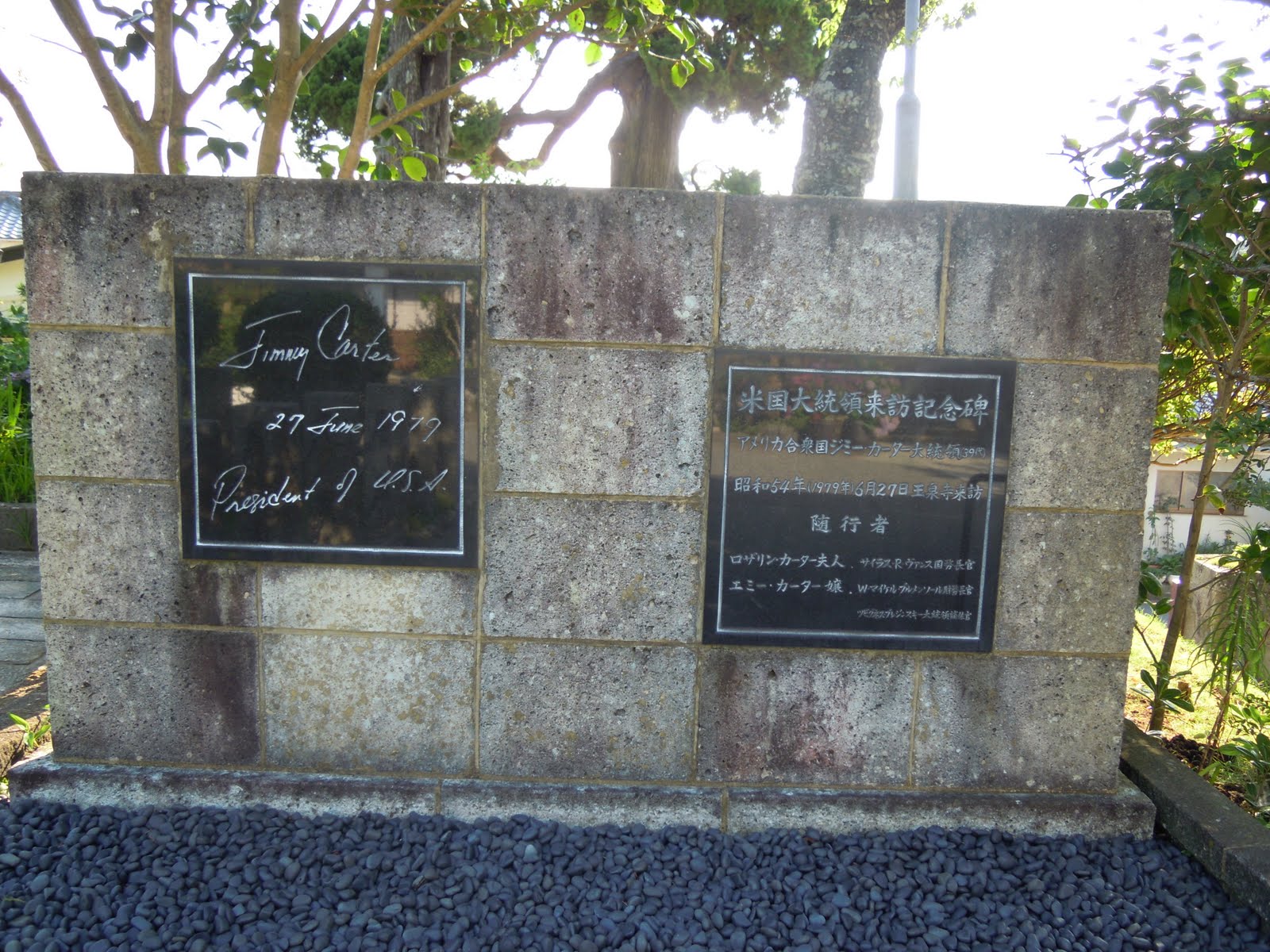
President Jimmy Cater accompanied by his wife and daughter visited this temple and left his memorial autograph on June 27, 1979.

Dogwoods were planted and this monument was erected to commemorate the bicentennial of the independence of  the USA.


In the precinct of Gyokusen-ji Temple there is Harris Memorial Hall.

About Gyokusen-ji


Commodore Perry's Bust in Shimoda

On March 31, 1854 Japan-US Treaty of Amity and Friendship was signed in Yokohama between Commodor Mathew Perry(1794-1858) and the Tokugawa shogunate. Soon after that Perry landed on Shimoda. On June 17 Shimoda Treaty was signed.

A monument to commemorate Perry's landing
Under those treaties Japan opened Shimoda port to foreign countries.

Shimoda port was the first port which was opened to foreign countries after Japan finished the national isolation policy(1639-1854).
American President George W. Bush sent a message to commemorate the 150the anniversary of the port opening.

Bush's message and its translation

Tokujiro Murata(1899-1973) was a sculptor who carved this bust.

The whole park

The bust was erected on October 18, 1966.
Written and posted by Mitsutoshi Masunari.