Wednesday, November 16, 2011

Chrysanthemum Exhibition at Shinjuku-gyoen Garden

In autumn we can enjoy beautiful chrysanthemums in Japan.
I went to Tokyo to see the exhibition of chrysanthemum at Shinjuku-gyoen Garden.
These are all different type of chrysanthemums in Japan.
This garden was owned by Naito, a vassal of Ieyasu, the first shogun of the Tokugawa Government. In 1906 it became an Imperial Garden. After World War Ⅱ it was opened to the public as a people's park.

Red leaves were very beautiful.


Shinjuku-gyoen Garden is in the vicinity of the second city center of Tokyo, Shinjuku.

There are many sycamores.
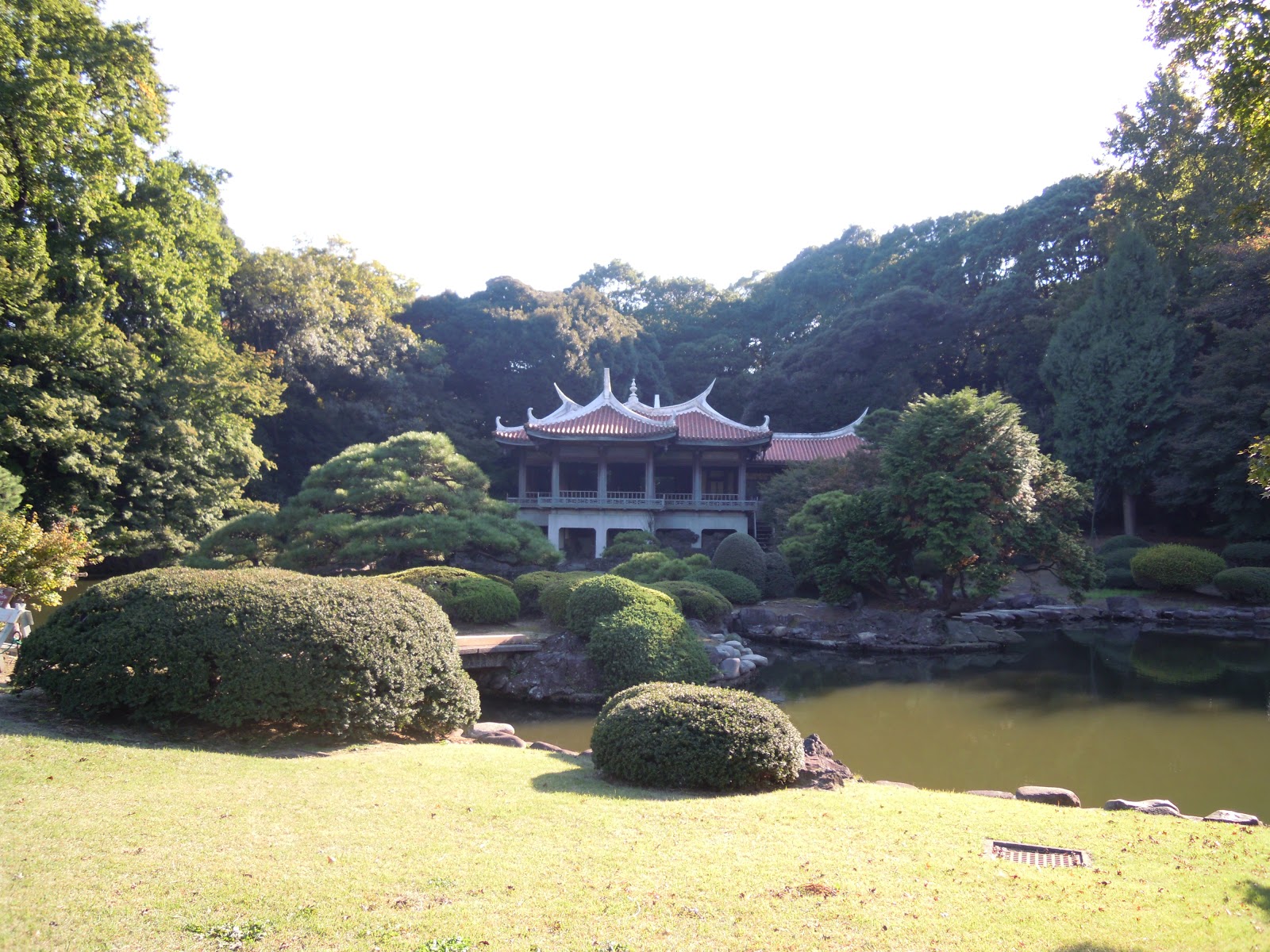
Old guest house 'Goryotei'

Chrysanthemum is an emblem of the Imperial Family of Japam.

Monday, November 7, 2011

Honmon-ji & Hongyo-ji Temples in Ota Ward of Tokyo

In Ota Ward of Tokyo there is a main temple of Nichiren-sect. That is called Honmon-ji Temple.
Nichiren's statue

Soshi-do, founder's hall

Five storied pagada beyond a basin
I have a reason to introduce this temple here. I wrote some stories  about Nichiren in this blog. He escaped from many risks in Kamakura caused by his aggressiveness. In 1274 he was pardoned from an exile to Sado Island and founded a temple in Mt. Minobu and named it 'Kuon-ji Temple'. He used it as the head temple of Nichiren Buddhism in Yamanashi Prefecture. In 1282 Nichiren sufferred from illness and stopped by Mr. Ikegami's mansion house in Ota on his way to Ibaraki for treatment at a hot spa(=onsen). He founded a big temple in a mountatin at the back of the mansion and named it Honmon-ji Temple. In a month Nichiren passed away at Mr. Ikegami's mansion.
In 1283 this mansion was donated to Nichiren's group and Hongyo-ji Temple was founded there. 
This way to Hongyo-ji Temple

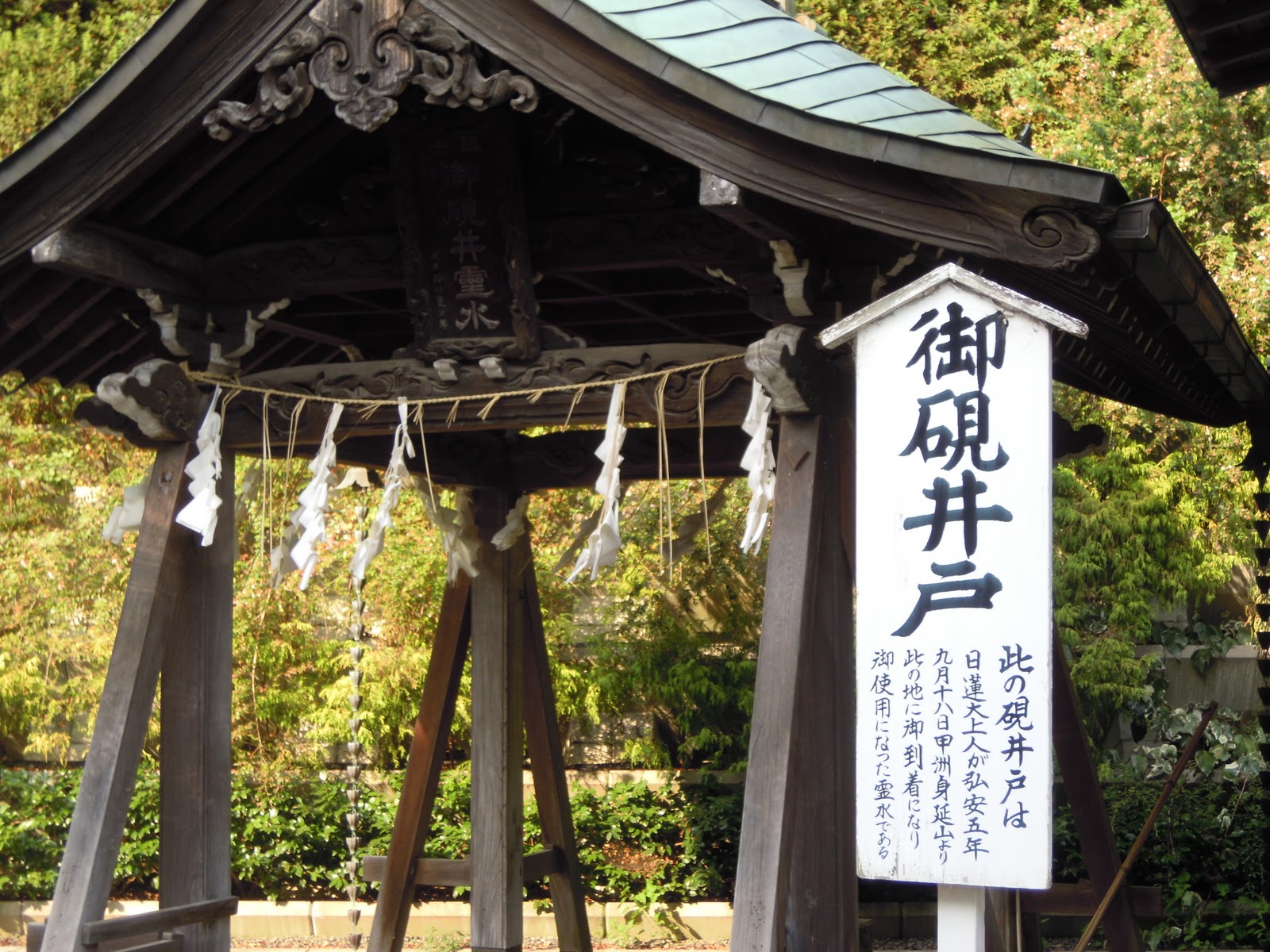
 Nichiren's well
This is where Nichiren passed away. 
 

Monday, October 31, 2011

Ryuko-ji Temple in Fujisawa

Ryuko-ji Temple is in the coastal area of Fujisawa which is a neighboring city of Kamakura. Today, I'd like to introduce this temple where Nichiren narrowly escaped from another crisis.
In this area, there used to be an execution ground.
Nichiren was an aggresive and outspoken priest. In 1271  he was finally  arrested and was taken to the execution ground.
This is where Nichiren had been detained before he was taken to the excution ground.
 Then, something happened to him.
There is an explanation on this notice board about what happened to Nichiren. The execution was suspended and Nichiren was exiled to  Sado Island.
Then, why was it suspended? Before I read this explanation, I learned that the lightning struck the sword. But it says because of the moonlight, the executioner was dazzled.
The main hall and a five-storied pagoda

This bell is special. We are allowed to ring it with a donation of 200 yen.
It is five minutes' walk from Enoshima Station of the Enoden line.
The Enoden line runs between Fujisawa Station and Kamakura Station. It's comfortable to ride the train and interesting to see a beautiful scenery from the train window.

Thursday, October 20, 2011

Three Nichiren Buddhism temples in the Matsuba-ga-yatsu area in Kamakura

Ankokuron-ji temple

Myoho-ji Temple

Chosho-ji Temple

In Kamakura there is a district named Matsuba-ga-yatsu where Nichiren(1222-1282) completed his thesis ' Rissho-ankoku-ron'. Three temples claim that his hermitage was in their precincts.
Nichiren, who founded his own sect of Buddhism, criticised other sects as evil creeds, so he was often attacked by the priests and believers of the other sects. To avoid those attacks Nichiren had to change dwellings. I guess he lived in all these three temples.

Nichiren's hermitage at Ankokuron-ji Temple
One at Myoho-ji Temple
 Temple bell at Chosho-ji Temple, it is said his hermitage used to be around this bell
 On October 10 in 1260, 40 days after Nichiren submitted his treatise to Tokiyori (Hojo) who was the then heir apparent of Hojo Clan and the former regent of the Kamakura Government on August 31, Nichiren's hermitage was attacked and set fire  by the other sects' priests. Nichiren narrowly escaped from the attack. It is said that a monkey led him to a cave and saved him.


Friday, September 23, 2011

Sumo Wrestling

On September 22, I went to Tokyo to see sumo wrestling.  Sumo tournaments are held six times a year, fifteen days each. In January, May and September they are held in Tokyo. The other three are held in March in Nagoya, in July in Nagoya and in November in Fukuoka. The above picture is Sumo Gymnasium in Ruogoku, Tokyo. 
A sumo wrestler Okinoumi arrived at the gym for his bout today.
Wrestlers show up altogether in two groups; one from the east, the other from the west. Above wrestlers appeared from the east.
These wrestlers appeared from the west.
The grand champion Hakuho showed up and is about to step on the ring flanked by two subordinates.
The left wrestler(Takanoyama) is from the Czech Republic and the right one(Kyokutenho) is from Mongolia. Thus sumo wrestling has become international.
Today's final bout was between Hakuho(left) and Kisenosato(right). Hakuho lost.

After the final bout a bow dance was performed to celebrate the winner.
Written and posted by Mitsutoshi Masunari.

Tuesday, September 20, 2011

Horseback Archery at Samukawa-jinja Shrine

Horseback archery is called Yabusame in Japanese which is said to have started about 1,500 years ago. But the oldest description about it was found in a history book written in 1096 during the Heian Period.
I went to Samukawa-jinja Shrine with a British educator Johnny to see a horseback archery ceremory on September 19. It was a national holiday in Japan so there were full of people there. 
The course was 215 meter long and there were three targets on the same side. In the center of the picture there is a target which is the second one. The first round started with 10 archers who were given two chances respectively. 

In the Kamakura Period(1192-1333) Yoritomo Minamoto who was the founder of the Kamakura Government encouraged to practice horseback archery to enhance warrior's ability of archery.
Then, three smaller targets were prepared for the second round. For one target two plates made of pottery have been attached together. Between the plates confetto have been stuffed.  Five archers were eliminated and contested their skill at the second round.
An archer named Yoshitaka Tanaka won with his horse Heian.
Written and posted by Mitsutoshi Masunari.
Johnny at Samukawa-jinja Shrine


Thursday, September 8, 2011

Enyuu-ji Temple in Meguro Ward of Tokyo

Enyuu-ji Temple is a Tendai-sect temple. It was founded by Jikaku Daishi aka Ennin in 853 and was named as Hofuku-ji Temple. During the Kamakura Period it was converted to Nichiren-sect temple in 1283 and was renamed as Hokke-ji Temple. It had been Nichiren-sect temple for about 400 years until it was forced to close by the Tokugawa Government during the Edo Period because  Buddist priests of this temple neglected believers of other sects' Buddhism.
In 1698 it was converted to Tendai-sect temple again and restarted. In 1834 this temple was renamed as the current name Enyuu-ji Temple.

This is the main hall of Enyuu-ji Temple.

Between the entrance gate and the main hall there is another gate ' Niomon' in which a pair of statues of Nio stand on both side of the gate.