Tuesday, December 14, 2010

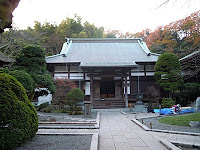
Hase-dera Temple


Hase-dera Temple is one of the icons of Kamakura. This temple is not only beautiful but also convenient to visit. It is only 5 minute walk from Hase station of the Enoshima line(=Enoden). From Kamakura station to Hase station it is only 5 minute train ride.
People are looking into one of the seven gods of fortune, Daikoku-ten. On the right is the main building of this temple where Hase-kannon has been placed.


We can enjoy the beautiful scene of Yuigahama-beach from the precinct. Below left is the entrance of the main building and on its right there is a picture of Rinzo.
In its center there is a revolving sutra.


It is said that people have 108 worldly desires. On the New Year's eve this bell is rung 108 times to get rid of them all.
Why not enjoy the holy temple with my comfortable English explanation?


Thursday, December 9, 2010

Seven Gods of Fortune in Kamakura


This is a picture which I took at Hongaku-ji Temple.
It says that the Seven Gods of Fortune in Kamakura and Enoshima are;
Benzaiten of Tsurugaoka Hachiman-gu Shrine, Hotei at Jochi-ji Temple, Bishamonten at Hokai-ji Temple, Irojin at Myoryu-ji Temple, Ebisu at Hongaku-ji Temple, Daikokuten at Hase-dera Temple, Fukurokuju at Mitama Jingu Shrine and Benzaiten at Enoshima Shrine with its order from above.

Wednesday, December 8, 2010

Jochi-ji Temple; Kamakura Sightseeing Spot-No.5


These are the pictures at Jochi-ji Temple which is close to Kita Kamakura station. This temple is ranked as No.4 zen temple in Kamakura.
After I walked through the tunnel I saw the statue of Hotei, one of the Seven Gods of Fortune in Kamakura.
 

Tuesday, December 7, 2010

Kencho-ji Temple; Kamakura Sightseeing Spot- No.4

Kencho-ji Temple was built by the Kamakura government's fifth regent Tokiyori Hojo in 1253. It belongs to the rinzai sect and has been designated as the No.1 zen temple among five prestigious zen temples in Kamakura. After entering the entrance gate(top) we see another gate(above).


This bell was forged by a skillful workman Shigemitsu Monobe in 1255 and has been designated as a national treasure.


Bodhisattva in the Buddha Hall
The plate of Hatto Dharma Hall
Buddha's ascetic training

A dragon painted on the ceiling of the Hatto. This picture was painted by a famous painter Junsaku Koizumi.  to commemorate the 750th anniversary of  the Hatto.
Kencho-ji Temple is fiteen minutes' walk from Kita Kamakura station.


Sugimoto-dera, Jyomyo-ji and Hokoku-ji Temples Walking in the east Kamakura area -No.3

Sugimoto-dera Temple
Sugimoto-dera Temple left is the oldest temple in Kamakura. It was built by the priest Gyoki in the Nara era in the eighth century. This temple is the first stop among the 33 temples for the pilgrims in the Kanto region. There are three statues of eleven-faced Goddess of Mercy, one of which is said to have been carved by Gyoki himself.
This temple belongs to Tendaishu-sect of Buddhism


Jyomyo-ji Temple

Jyomyo-ji Temple (right) is the fifth highest ranking Buddhist temple in Kamakura. In the precinct there is a tea house(below) where you will be able to enjoy the taste of green tea.


This temple belongs to Rinzaishu-sect of Buddhism.

Hokoku-ji Temple
Hokoku-ji Temple below flourished as a family temple of both the Ashikaga and Uesugi clans.
This temple has a nickname 'The Bamboo Temple'.


Myoru-ji and Hokai-ji Temples and Egara-tenjin and Kamakura-gu Shrines;Walking in the east Kamakura area - No.2

Myoru-ji Temple

A wooden idol of Nisshin-shonin at Myoryu-ji Temple who warned the 6th shogunate of the Ashikaga government and was tortured by him. This is one of the Seven Gods of Fortune in Kamakura, Jurojin. This temple belongs to Nichirenshu-sect of Buddhism Hokai-ji Temple

Hokai-ji Temple was built by the order of the Emperor Godaigo to morn the soul of Takatoki Hojo, the fourteenth regent of the Kamakura and his clan. This site used to be where Hojo's residence existed.


Egara-tenjin Shrine


The picture on the right is Egara-tenjin Shrine. It is one of the three shrines where Michizane Sugawara, the God of Wisdom, has been enshrined. The other two are Dazaifu-tenmangu Shrine in Fukuoka and Kitano-tenmangu Shrine in Kyoto. The picture on the left is a monument of the Japanese cartoonists on which their cartoons are being carved.


Kamakur-gu Shrine


Kamakura-gu Shrine was built by the order of the Meiji Emperor to morn the death of Prince Morinaga, the son of the Emperor Godaigo.


Prince Morinaga was detained in the cave cell below and murdered after nine months' cofinement.


This is a portrait of Prince Morinaga.

Hongaku-ji and Myohon-ji Temple;Walking in the east Kamakura area-No.1


Hongaku-ji Temple
It's fun to walk in the east Kamakura area starting with the Hongaku-ji Temple which is within two minutes from the east exit of JR Kamakura station. The left picture is its main building and the right one is Ebisu-do Hall where Nichiren lived after he returned from his exile on Sado Island.

cf. Nichiren was a Buddhist monk who lived in the Kamakura era.

Myohon-ji Temple
Nichiren's statue is in the precinct of Myohon-ji Temple which was built to honor the Hiki family after Yoshikazu Hiki was murdered by Tokimasa Hojo.
The left picture is the main building of Myohon-ji Temple which is within five minutes' walk from Hongaku-ji Temple.
The right statue is that of Nichiren.


Nichiren came to the area below almost every day and preached the benefit of following the lotus sutra.


To be continued to No.2