Saturday, July 2, 2011

Who was the first foreigner to climb Mt. Fuji?

Mt. Fuji is the highest mountain in Japan. Its height is 3,776m. From the foot to the fifth station(=the peak is the tenth station) we can drive. 
I took this picture on my way to Mt. Fuji. It was raining and foggy, but I could see Mt. Fuji by chance.
The third station.  2,000m above sea level. Drive slow.

The fourth station. 2,300m above sea level. You'll soon arrive.


When I arrived at the fifth station, it stopped raining.


I saw another portrait of Sir Rutherford Alcock.

Sir Rutherford Alcock

Plaque

Mt. Ashitaka from the observatory of the fifth station of Mt. Fuji
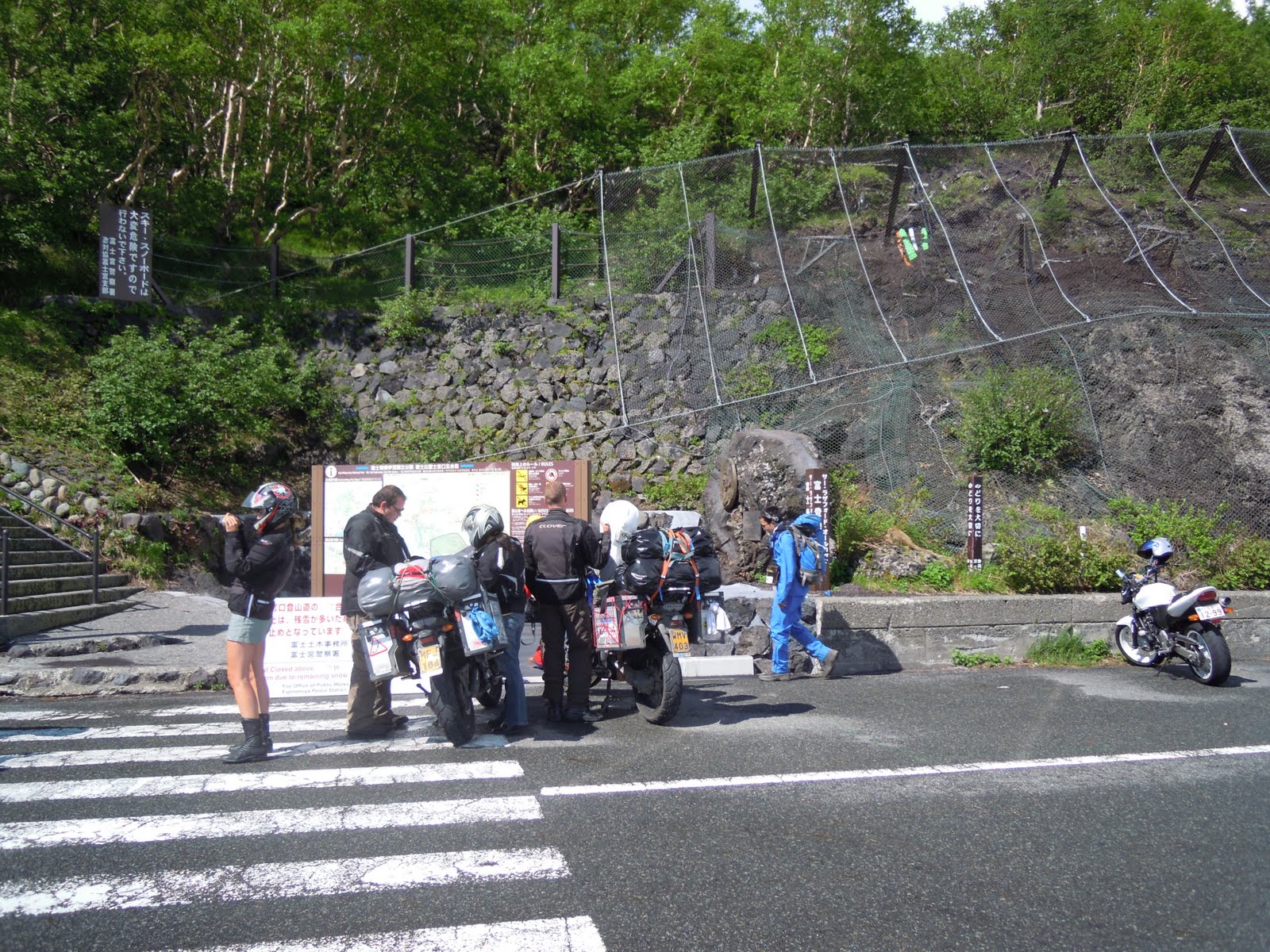
 Foreign hikers
Rutherford Alcock was the first foreigner to climb Mt. Fuji.What are these people's orders to climb Mt. Fuji as foreigners?
Written and posted by Mitsutoshi Masunari.


Friday, July 1, 2011

Sir Rutherford Alcock in Atami

Rutherford Alcock(1809-1897) was the first British diplomatic representative in Japan. On March 1, 1859 he was appointed to Consul General in Japan. He opened the British Consulate General in Edo(=now Tokyo) within the ground of Tozen-ji Temple on July 6.  On Dec.23,1859. Alcock was promoted to Envoy Extraordinary and Minister Plenipotentiary which is a diplomat of the second class ranking between an Ambassador and a Minister Resident under the terms of the Congress of Vienna of 1815. At the same time the British Consulate General in Edo(=now Tokyo) was promoted to the British Legation in Edo.
Tozen-ji Temple in Tokyo which was used as a diplomatic facility 'The British Legation in Japan'.
Alcock climbed Mt. Fuji on September 11, 1860 as the first non-Japanese to climb it. He also visited Atami with his pet dog.

 This is a portrait which is being hung on the wall of a park in Atami.
In his portrait you can see his pet 'Toby'.
In Atami there is another monument which is probably erected near an inn he stayed.
In the center of this photo there are two monuments. The big one is a monument for Alcock and the small one is his pet's tomb stone.
To be continued to 'Who was the first foreigner to climb Mt. Fuji'.
Written and posted by Mitsutoshi Masunari.

Atami Castle

Atami Castle was first built in 1959. So, unlike most of the other castles, it doesn't have any legends. However, it is worth visiting it; there are exhibition rooms and an observatory. 
Armors

Helmets

Swords

Nagamochi- a large oblong wooden chest

Matchlocks

A portable shrine made of shells

A float for festivals

Atami harbor from the observatory
A basket

To be continued to Sir Rutherford Alcock in Atami
Written and posted by Mitsutoshi Masunari
 

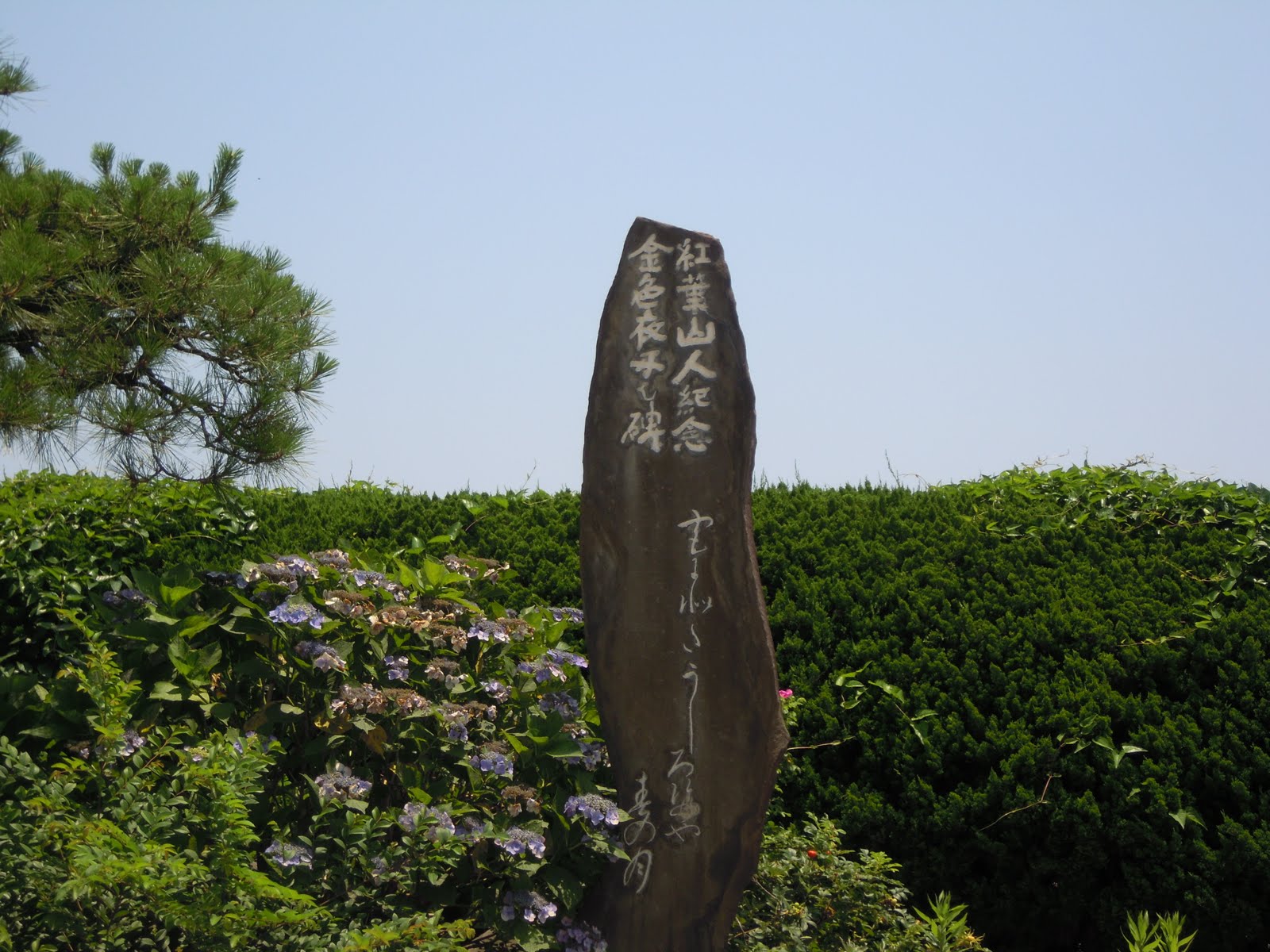
A novel that made Atami famous; A statue of Kan-ichi and O-Miya

There was a well known auther Koyo Ozaki(1868-1903) in the Meiji Era. His most renowned works were 'Konjiki Yasha' which literally means 'The Golden Demon' but its English title is 'Usurer'. This novel made Atami so famous that many people began to visit this town. The main characters were a young man named Kan-ichi and his girl friend O-Miya.  In Atami there are a statue of 'Kan-ichi and O-Miya' and a pine tree nicknamed O-Miya's pine tree.
A pine tree and a wooden plate saying ' O-Miya no Matsu'. 'Matsu' is a Japanese word for a pine tree and 'no' is a possesive particle such as 'of' in English. Miya was this female character's first name, but people called women's first name with a prefix 'O'. 

Do you understand why Kan-ichi is kicking O-Miya with his wooden sandal? For Kan-ichi, O-Miya was a betrayer. Although they were once engaged, O-Miya got married to another man who was a billionaire. Kan-ichi met O-Miya in Atami and asked her the reason but she held her real intentions. So, Kan-ichi lost his temper and kicked her.

O-Miya must have been a pretty woman.
After Kan-ichi was snubbed by O-Miya, he became an 'userer', the English title of this novel.
Koyo Ozaki's monument also stands near the statue.
Written and posted by Mitsutoshi Masunari.
 

Thursday, June 30, 2011

Atami - A resort town with onsen hot springs

Atami City is located in the eastern end of Shizuoka Prefecture which is to the west of Kanagawa Prefecture. So, it takes only 57 minutes from Yokohama Station by the Express Odoriko and 39 minutes from Tokyo Station by the Super Express Hikari.
Atami literally means 'hot ocean', a reference to the town's famous onsen hot springs.
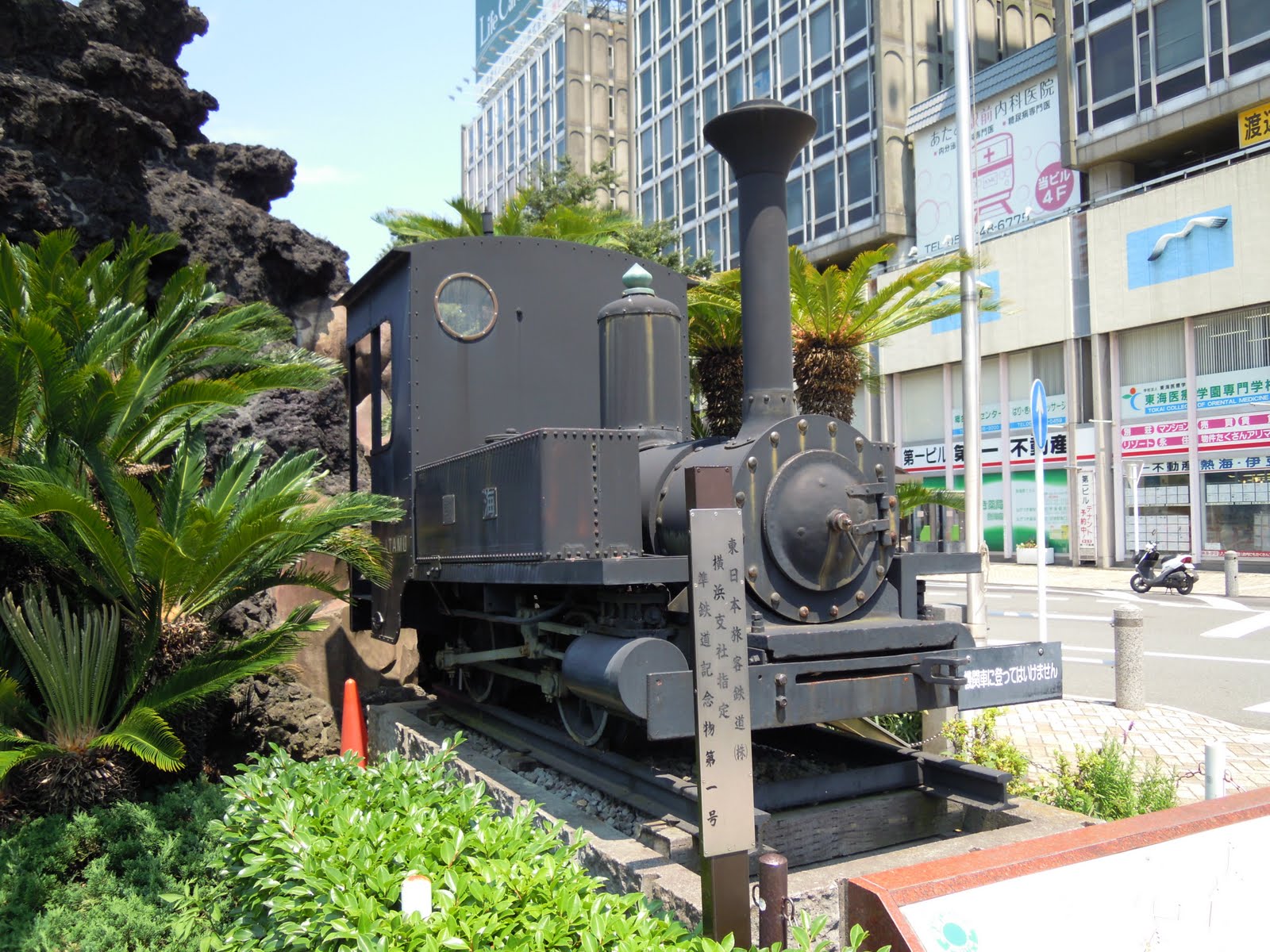
In front of the station a steam locomotive is being displayed.

This SL was used in the early 20th century to bring tourist to Atami.

In 1604 the first shogun Ieyasu of the Tokugawa Government visited Atami.
In 1662 the fourth shogun Ietsuna ordered to bring  barrels which were full of onsen water to Edo Castle.The home delivery service of onsen, so-called 'Onsen purveyor to Tokugawa shogun' peaked at the time of the eighth shogun Yoshimune. From 1726 to 1734, as many as 3,643 barrels were brought to Edo(=Tokyo). It took 15 hours from Atami to Edo Castle. When they arrived in Edo, the hot water tempereture fell to the moderate degree so that the shogun bathed comfortably.
To commemorate the 400th anniversary of Ieyasu's stay in Atami, Atami Onsen Association donated a geyser- an intermittent spring -to Atami City so that Atami visitors can warm their legs and feet.
This geyser is also in front of Atami Station.
To be continued to "A nobel that made Atami famous; A statue of Kan-ichi and O-Miya".
Written and posted by Mitsutoshi Masunari.


Tuesday, June 21, 2011

Japanese Robinson Crusoe in the Edo Period

I have already introduced stories about a castaway 'Jeseph Heco(1837-1897) ' in my yahoo blog several times.
His original name was Hikozo Hamada, a man born in the suburbs of Kobe of the Hyogo Prefecture. It was a fishing village named Harima.
The reason why I introduced him in this google blog: I was so pleased to find a you-tube video about Heco.
The tale of a Japanese castaway by Asian Art Museun in San Francisco
This is a 40 minutes' video. I am sure you will enjoy it.
-Summary-
"When Hikozo was 13 years old, a fishingboat wrecked and drifted in the Pacific Ocean until 17 crews including him were rescued by an American freighter. They were taken to San Francisco. Hikozo was already 21 when he finally came back to Japan as an American -Jeseph Heco."
Written and posted by Mitsutoshi Masunari.
P.S.
Stories about Hikozo Hamada in my yahoo blog
1st :The first Japanese American
2nd : Heco's hometown in Harima of Hyogo Prefecture
3rd: Jeseph Heco in Nagasaki
Hikozo Hamada aka Jesef Heco in his hometown

Tuesday, June 14, 2011

Meiji-jingu Shrine in Tokyo

The Edo Period started in 1604 when Ieyasu Tokugawa founded the government in Edo. There were 15 Tokugawa Tycoons during the period. Yoshinobu Tokugawa was the 15th and the last Tycoon who  returned the sovereignty to the Imperial Court in 1867. Thus, all through the Edo Period Tokugawa Tycoons governed Japan. Tokyo was called Edo before the Meiji Era(1868-1912). So, we call it the Edo Period.
Meiji-jingu Shrine was built to enshrine Meiji Emperor and his consort Empress Shoken. Construction began in 1915 and completed in 1920.
The picture on the right shows the second torii-gate to the shrine.

This is the main entrance-gate to the shrine.
This is the main hall.
Holy trees.

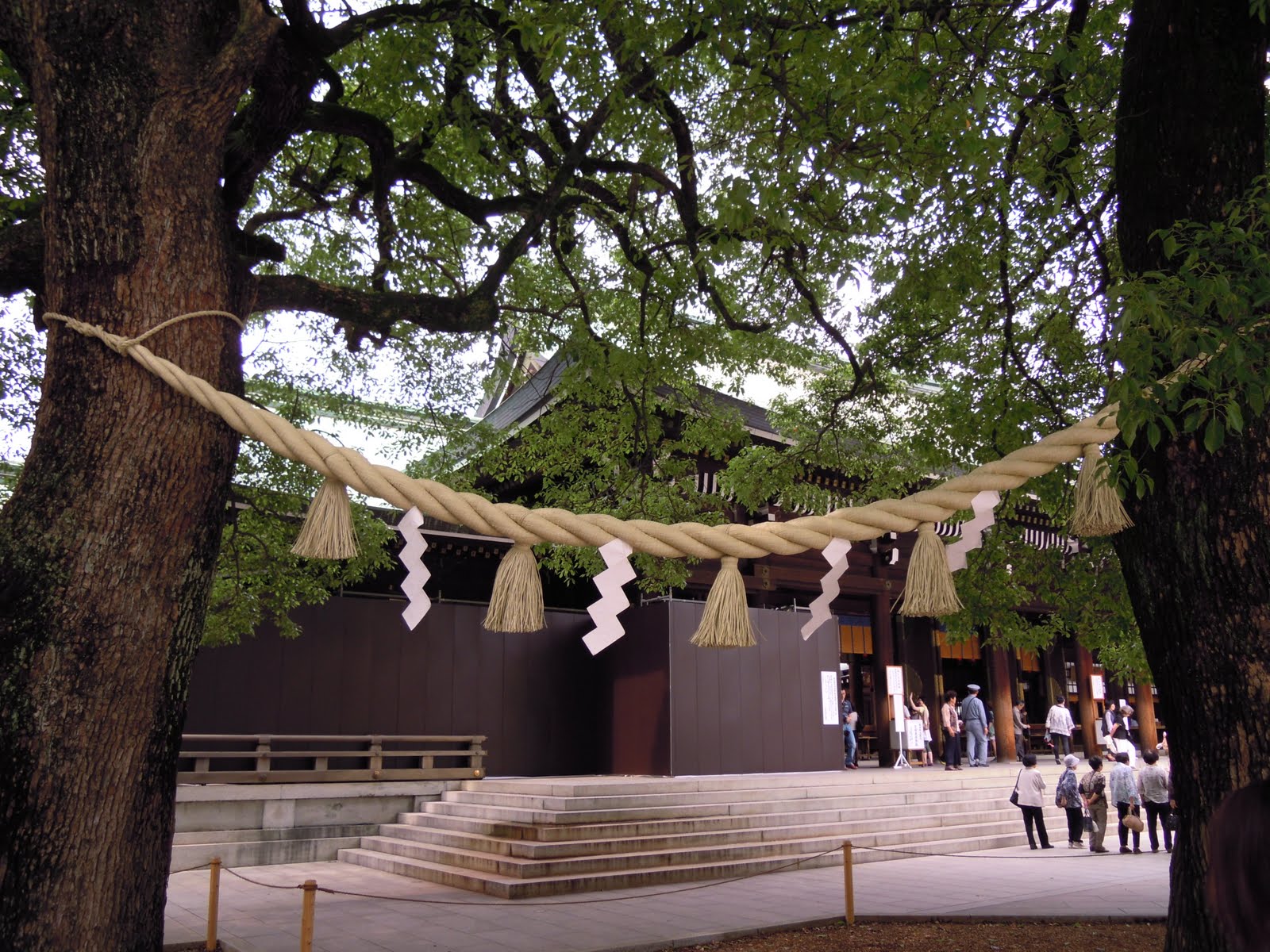
 Japanese people's staple is rice. We are able to have a bumper harvest in autumn with the help of nature. The above picture shows a twisted rice-straw rope with strips of white paper and some pieces of straw. It represents clouds, lighting and rain respectively, and is a symbol of deitties identical with nature.  
 Every new year between the 1st and the 3rd of Januray 3.2 million people visit and pray for their happiness of the year.In this sense this is the most popular shrine in Japan. The location is at Harajuku of Shibuya Ward in Tokyo.
Written and posted by  Mitsutoshi Masunari.