Wednesday, June 8, 2011

Nagasaki-7 ; Other pictures I took in Nagasaki

I walked around Nagasaki and took pictures randomly.
Holland Street which connects Nagasaki Station and Glover Garden
The first bowling arena in Japan

Castella, a sponge cake was introduced by a Portuguese missionary in 1556. This is the head office of a castella cake shop named 'Bunmeido'
The Nagasaki Highway
A public hall along the Nagasaki Highway
A streetcar
Statue of Peace
An atomic bomb was dropped in the Urakami area of Nagasaki City on August 9, 1945. It was the second atomic bomb attack after Hiroshima was hit on August 6, 1945. 
This is the end of my report about my short trip to Nagasaki on June 1, 2011.
PS
After the sightseeing in Nagasaki, I went to Fukuoka to enjoy a baseball game.

Monday, June 6, 2011

Nagasaki-6 ; The first native speaker who taught English to Japanese interpreters


His name is Ranald MacDonald(1824-1894). I am confident in the spelling,'Ranald'. Don't worry!
Believe it or not; he dared to come to Japan in 1848 which was during the period of Japan's national isolationism(1639-1854) with his own will.  His father was a Scottish American and mother was a daughter of a local tribal chief. He believed that his tribe's ancestors were Japanese and had the temptation to go to Japan. 


Click the photo above and you will know the detailed story. Anyway, he became a crew of a whaleship and got off the ship off the coast of Japan and rowed a boat to a small island.In the end, he was sent to Nagasaki as an illegal intruder and detained in a dungeon for six months until he was sent back to the United States by an American ship. 
During his detention in Nagasaki, he taught English to Japanese interpreters. Among them there was a man named Einosuke Moriyama who later played an important role as a chief interpreter between Commodore  Perry and the Japanese government.
His monument was built at the site of the former dungeon.After Ranald MacDonald went back to the States, he reported his experience to the federal government that Japan was not a barbarian country. His report triggered America's policy to let Japan end the national isolationism and send Commodore Perry to Japan. Thus, Ranald contributed to finish Japan's national isolationism smoothly and cultivate a good relationship between Japan and the United States. 

Nagasaki-5 ; Siebold and Narutaki Cram School

This ia a bust of  Philipp Franz Balthasar von Siebold(1796-1866) at a site where he lived and taught western medicine to Japanese would-be doctors in Nagasaki.
This was the entrance to his house.

I already introduced Siebold and his family in my yahoo blog when I went to see his bust in Tsukiji, Tokyo on February 27, 2011. Click here and you will be able to read it.
Anyway I am pleased to see the historic site where Narutaki Cram School existed.  
Written and posted by Mitsutoshi Masunari.
PS
This picture was displayed at Siebold Museum.The left sign(↑) shows Siebold himself and the right one shows his older son who was hired by the British Legation in Tokyo worked with another interpreter Ernest Mason Stow whom I introduced in my yahoo blog.

Sunday, June 5, 2011

Nagasaki-4 ; Obaku Buddhism and their temples in Nagasaki

1.Kofuku-ji Temple of Nagasaki
Kofuku-ji Temple of Nagasaki is the oldest Obaku-sect Buddhist Temple in Japan. It was built by a Chinese Buddhist priest Shin-en  (1579-1648) in 1624.
The second chief priest Mokushi-nyojo(1597-1657) was also a Chinese. He was good at architecture, so he instructed to build  Megane-bashi Bridge.
This is Megane-bashi Bridge. Megane means spectacles in Japanese.

Mokushi-nyojo's statue beside the Nakajima River
2. Sofuku-ji Temple
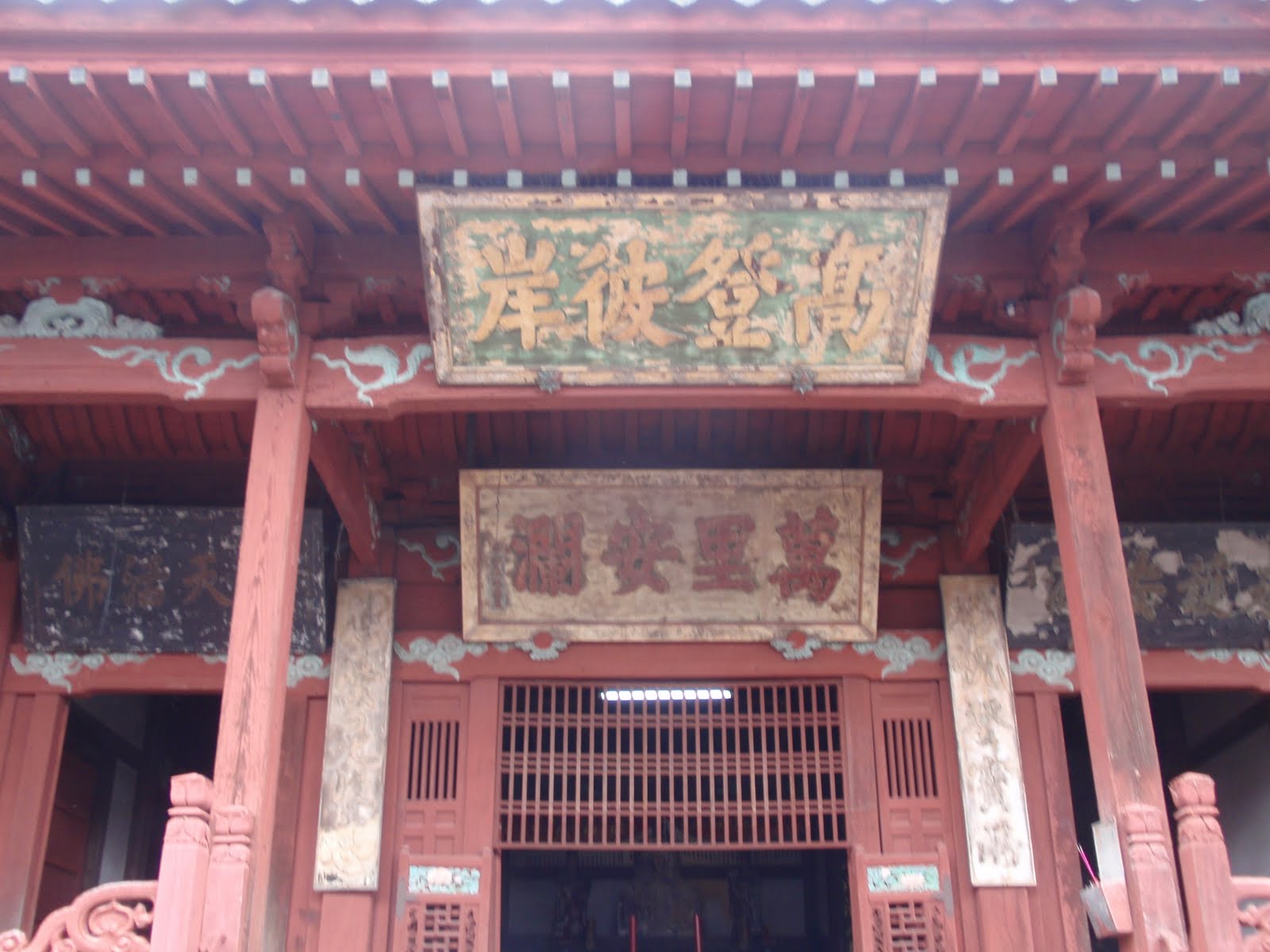
Shortly after the construction of Kofuku-ji Temple, Chinese merchants living in Nagasaki asked the Nagasaki feudal lord for permission to build a temple with their Chinese hometown's temple style. It is recorded that Sofuku-ji temple was built in 1629 by the Chinese merchants who came from Fujian Province. 
This gate named Daiichi-homon is designated as a National Treasure.
About Daiichi-homon.
The main hall called Daiyu-hoden was first prefabricated in China and then transported by a Chinese ship and constructed here in 1646. As the oldest existing structure to retain the Obaku-style of the Ming Dynasty, this hall is highly evaluated and is designated as a National Treasure.

Buddhist statues in the main hall

About the Beddhist statues in the main hall

Maso Gate. Maso was a Chinese woman who actually existed in China about 1,000 years ago. Because of her psychic power she was apotheosized and regarded as a Goddess to save the country and the people.

The outer gate for Maso Gate


This cauldron was made by the second chief priest in 1682 to boil porriadge for the people who were sufferring from starvation.

This bell was forged in 1647 by a famous blacksmith Ayama Kunihisa.


Guan Yu(in Chinese) or Kan-U(in Japanese) was a general serving under the warlord Liu Bei during the late Eastern Han Dynasty. He was also apotheosized and regarded as a God for merchants.

A statue of Kannon
A statue of Idaten
3. Ingen, the founder of Obaku Buddhism

The Obaku Buddhism is one of three sects of Zen in Japanese Buddhism with Soto and Rinzai.It was founded by Ingen Ryuki(=Yinquab Longqi,1592-1673) in 1661 after he came to Japan.Ingen arrived in Nagasaki in 1654 at the request of the then chief priest of Kofuku-ji Temple to fill the vacancy of the chief priest's seat of Sofuku-ji Temple in Nagasaki.In 1660 Ingen was allowed to found a temple in Uji, Kyoto by the fourth Shogun Ietsuna Tokugawa. The next year a new temple was completed and Ingen named it Obaku-zan Manpuku-ji Temple which was the same name as the temple in his hometown in China.He didn't use the sect's name Obaku at the time of the foundation but rather he named it as the orthodox Rinzai-sect. When Ingen recognized the difference between the Japanese Rinzai Buddhism and that of China, he began to use the sect's name Obaku Buddhism.

RE: Obaku-sect's temple in Tokyo- Kaifuku-ji Temple

Saturday, June 4, 2011

Nagasaki-3 :Glover Garden

After I saw the former British Consulate of Nagasaki, I visited Glover Garden.
Thomas Blake Glover(1838-1911) was a Scottish merchant who came to Nagasaki in 1859. At first he worked for Jardin Matheson and two years later he founded his own firm- Glover Trading Co. His achievement was so great that he was awarded the Order of the Rising Sun in 1908.
This is a statue of Puccini(1858-1924).
This is a statue of Tamaki Miura(1884-1946), an opera singer who became famous for her role as Madam butterfly. 
Glover's family picture. From left to right, Tomotaro(his son),sister,brother, daughter,Glover and Tomitaro's wife
At a reception held by Admiral Heihachiro Togo in 1905. Togo is sitting in front of Glover who is wearing a silk hat in the center.

Floats used for the Nagasaki's festival 'Kunchi'
Dragons are also important tools for the Nagasaki festival.
Another soprano, Teiko Kiwa(1902-1983).She was born in Yokohama. When she was 17, she went to Milan. In 1922 she made a debut as an opera singer playing the role as Madam Butterfly. Kiwa was her beloved grandmother's first name who got married to a Dutch pharmacologist. Her mother also got married to a Dutch.

These are the pictures I took at Glover Garden.

Friday, June 3, 2011

Nagasaki-2: The former British Consulate of Nagasaki

I was amazed to see a red brick building in Nagasaki. This building was built in 1907 by an engineer named William Cowan for the use of the British Consulate.
This is the entrance gate of theBritish Consulate.
This is the whole structue of the building.
This is the right side of the building.
This is the left side of the building.
I took this picture from the back yard.
This photo shows a boat being moored. It seemed that the coast line was close to the consulate.
This building had been well preserved and used as an art museum. Now it is closed for repairs.

Nagasaki-1 : Dejima

I made a short trip to Nagasaki. This was my first visit to this city, so I was excited.I walked from my hotel to Dejima Harbor.
There was a sign saying 'Nagasaki Dejima Harbor.' Dejima was an offshore island which was artificially build to controll Portuguese in 1636. In 1639 Portuguese were ousted to avoid their colonialism and Christianity.In 1641 Dutch merchants' buildings were transferred from another city Hirado to Dejima and Dutch people were allowed to live there to  have a trade relationship with Japan during the national isolation period(1639-1854) without armaments and missions of Christianity.
A ship is being moored at Dejima Harbor. Dejima finished its role for secluding Portuguese people after 1834. In 1897 this area was reclaimed and Dejima has not been an island any more. From Dejima I walked through a beautiful park 'Nagasaki Mizube no Mori Park' and took a picture of the Megami Bridge. Megami means Goddess in Japanese.